DXH-240 · Hydrogen Leak Detector

Smaller molecule. Smaller leaks found.
The DXH-240 tracks down micro-leaks in HVAC and refrigeration coils, automotive A/C systems and EV battery enclosures with safe, non-flammable 5% hydrogen / 95% nitrogen tracer gas — catching leaks that soap, dye and ordinary sniffers walk right past.
"Passed the bubble test" doesn't mean leak-free
Every detection method has a floor — the smallest leak it can see. Anything below that floor gets signed off as tight. Here's where each method stops.
Shorter bar = smaller leak detected. Bars shown on a log scale. Refrigerant-loss equivalents are approximate.
Systems checked only with coarse methods can still be losing refrigerant below those thresholds — which is why they so often show up under-charged, or fail outright, within their first year of service.
The physics works in your favor
Hydrogen is the lightest, smallest molecule there is. That one fact makes it the most effective tracer gas you can put in a system.
Slips through anything
H2 escapes through openings too small for refrigerant, dye or bubbles to reveal.
Clean background
Natural air carries only a trace of hydrogen, so readings stay sharp and false alarms stay low.
Non-flammable blend
At 5% hydrogen the mix stays below the flammability threshold — safe in occupied bays and production lines.
Nothing vented
No refrigerant is released while you search, and the tracer gas costs far less than helium.
Made for the service bay, the rooftop and the production line
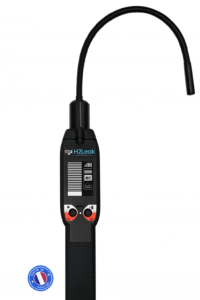
A handheld sniffer for tightness testing at atmospheric pressure, built for daily jobsite use and easy field maintenance.
Electrochemical H2 cell
High-sensitivity sensor tuned for H2/N2 tracer gas, reading from 1 to 1,000 ppm.
Two working modes
DETECTION zeroes automatically for scanning; TRACK holds a manual zero to chase a leak to its source.
4-step sensitivity
Start high to find the area, then step down to isolate the exact point.
30 cm flexible probe
Shape-memory steel core holds its bend; interchangeable filter tip keeps debris out.
LED at the tip
Built-in light at the probe head for dark cabinets, engine bays and coil packs.
Bar graph + tone
OLED ramp and rising audio signal let you hunt by ear without watching the screen.
Four kinds of work, one detector
Same tracer gas, same tool — only the system and the suspect joints change.
HVAC systems
Track down the slow loss in rooftop units, split systems, heat pumps and long line-set runs — the kind that shows up as an under-charged system months after the install.
- Evaporator & condenser coil brazes
- Line-set flares & Schrader cores
- Reversing valve & TXV fittings
Commercial refrigeration
Walk-ins, display cases and rack systems lose product and margin to slow leaks. Finding leaks down to 0.10 oz/yr also supports EPA refrigerant management rules and GreenChill leak-reduction goals.
- Case evaporator coils & drain lines
- Rack manifolds & header joints
- Machine-room fittings & valves
Automotive A/C
Locate R-134a and R-1234yf system leaks without venting refrigerant or waiting days for UV dye to show up at the leak.
- Compressor shaft seals & manifolds
- Condenser & evaporator joints
- Hose crimps & O-ring connections
EV battery packs
Verify welded seams, gasketed lids and cooling circuits, where a failed seal can mean coolant loss, corrosion or a thermal event.
- Enclosure welds & lid gaskets
- Cooling plates & thermal-loop fittings
- End-of-line module testing
Running a DXH-240 leak check
The same six steps apply to a rooftop condenser, a vehicle A/C joint or a battery enclosure.
Recover
Recover any refrigerant in the system before the tracer gas goes in.
Pressurize
Fill the coil, line set or enclosure with the 5/95 H2/N2 blend, within the equipment's rated test pressure.
Sweep
Pass the tip close to every joint at a slow, steady pace.
Tip: about ¼″ away, roughly 1 inch per secondNarrow in
Begin on the most sensitive setting, then step down — or switch to TRACK — to isolate the exact point.
Confirm
Mark and re-verify the location before opening the system for repair.
Re-test
After the repair, check the same joint again and sweep the rest of the system for any others.
DXH-240 technical data
| Tracer gas | 5% H2 / 95% N2 (forming gas) |
|---|---|
| Sensitivity | 1×10⁻⁵ cc/s for H2/N2 mixture (≈1 g/yr refrigerant equivalent); 1 – 1,000 ppm H2 under optimal conditions |
| Sensor | Interchangeable electrochemical detection cell |
| Sampling | Active suction flow for fast response and quick clear-down |
| Probe | 30 cm flexible probe, shape-memory steel, interchangeable filter tip, LED light at the head |
| Modes | DETECTION (automatic zero) and TRACK (manual zero) |
| Sensitivity settings | 4 positions |
| Warm-up / response | ~60 s cell heating · ~1 s response |
| Display & alarms | OLED progressive ramp with audio signal; battery and ambient contamination indicators; continuous self-check for cell error and low battery |
| Power | Built-in rechargeable battery, ~8 h runtime; USB-C, full charge in ~12 h |
| Housing / weight | Shock-resistant plastic case · 0.35 kg |
| Operating range | 10–40 °C (50–104 °F), jobsite and maintenance use |
| Supplied with | Transport case, charger, user manual |
| Compliance | CE marked |
| Warranty | 12 months |
Safety: The DXH-240 is not explosion-proof. Never use it in hazardous or explosive atmospheres, or where hydrogen concentration may reach its lower explosive limit (LEL).
Designed around uptime
Wear parts swap in the field, so a worn sensor or probe doesn't take your detector off the truck.
Application
- Handheld tightness testing
- High-performance H2/N2 sensor
- Sniffing at atmospheric pressure
Design
- DETECTION / TRACK mode selector
- 4-position sensitivity
- Graphic ramp with audio signal
- LED light at the probe head
Maintenance
- Field-replaceable cell and suction pipe
- No need to ship the unit for wear parts
- Spare parts readily available
- Optional protective cover
DXH-240 or DXR-240?
Both use the same proven hydrogen tracer method. The difference is whether you also need to sniff refrigerant directly.
DXH-240
Dedicated hydrogen tracer gas detector.
- H2/N2 tracer gas
- HVAC, refrigeration, auto A/C and EV batteries
- DETECTION and TRACK modes
- LED light at the probe tip
DXR-240
Hydrogen tracer gas plus direct refrigerant detection.
- H2/N2 tracer gas
- HFC, HFO and HC refrigerants
- Test charged systems without recovering first
- Universal or H2-only sensor cell
Questions we hear most
What tracer gas does the DXH-240 use?
A non-flammable blend of 5% hydrogen and 95% nitrogen, often called forming gas or 5/95 tracer gas. Because the hydrogen content sits below the flammability threshold, it's safe for occupied service bays and production areas.
Where do I buy H2/N2 tracer gas?
Forming gas is stocked by most industrial and welding gas suppliers. Ask for 5% H2 / 95% N2 and use a regulator rated for the test pressures you need.
Is hydrogen leak detection safe for automotive A/C work?
Yes. Recover the refrigerant, pressurize the system with the 5/95 blend, and sniff the joints and fittings. No refrigerant is released to the atmosphere during the search.
Can it find leaks in EV battery packs?
Yes. Forming gas is a standard tracer for battery enclosures, cooling circuits and thermal plates. Hydrogen's tiny molecule finds micron-level leaks, and its low natural level in air keeps false readings down.
What's the difference between DETECTION and TRACK modes?
DETECTION re-zeroes automatically to the surrounding air, which is ideal for sweeping a system. TRACK uses a manual zero, so you can work in an area with some background hydrogen and still follow the signal to the strongest point.
How long does the battery last?
Around 8 hours per charge — a full shift. It charges over USB-C, taking about 12 hours from empty.
Can I use it in hazardous or explosive atmospheres?
No. The DXH-240 is not explosion-proof and must never be used in hazardous or explosive atmospheres, or where hydrogen may reach its lower explosive limit.
What's the warranty?
The DXH-240 carries a 12-month warranty, and wear parts such as the detection cell and suction pipe can be replaced in the field.
Stop guessing where the leak is
Get pricing on the DXH-240, ask about fleet orders, or let us help you pick the right detector for your application.