DXR-240 · H2/Refrigerant Leak Detector

Find the leak before the charge — and after it.
Most leak detectors only work once refrigerant is in the system. The DXR-240 sniffs HFC, HFO and HC refrigerants on running equipment and detects safe 5% hydrogen / 95% nitrogen tracer gas on new or evacuated lines. Two jobs, one handheld.
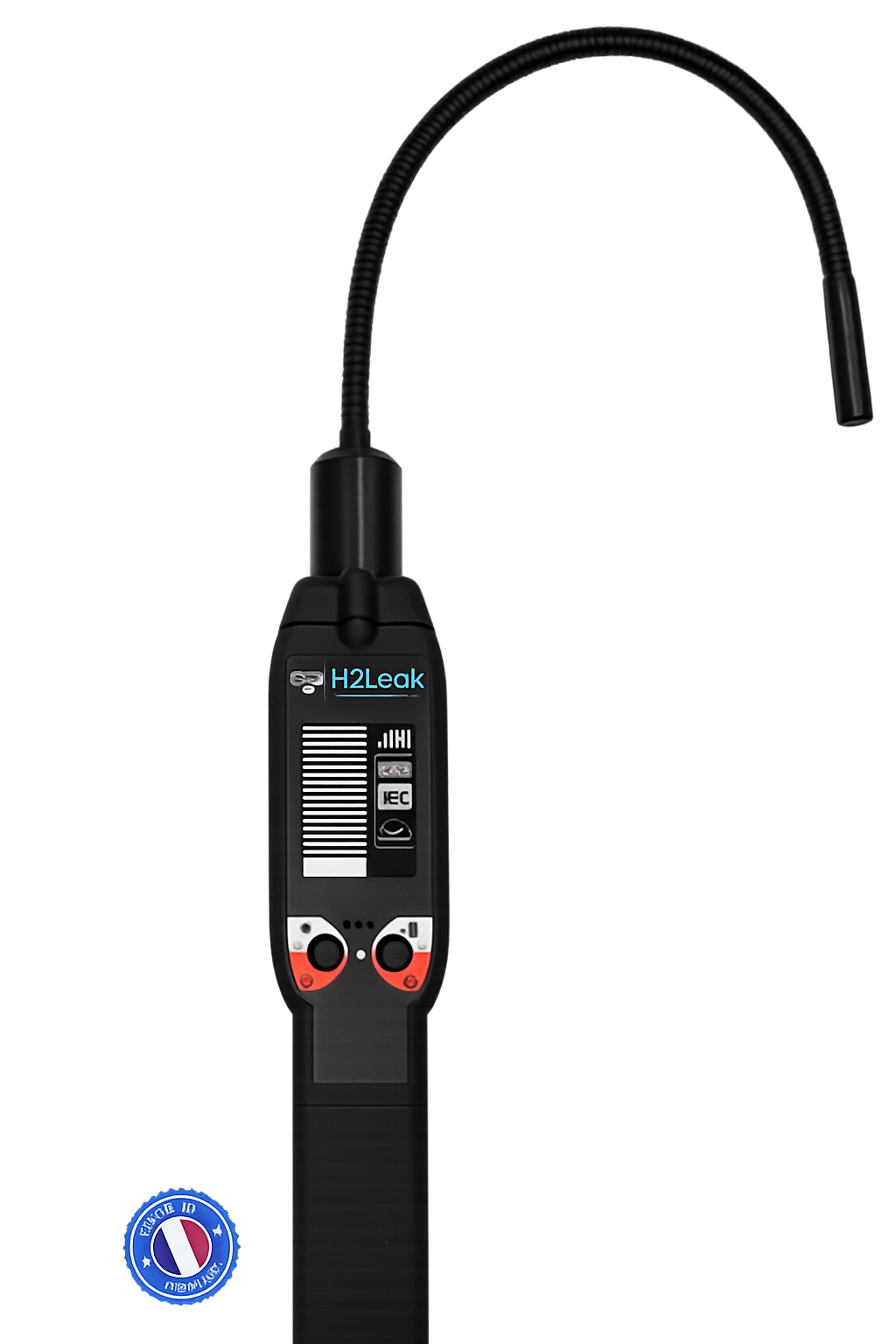
Wherever the system is in its life, you can test it
A big share of leak checks happen when there's no refrigerant to sniff. The DXR-240 switches between gas families so you're never stuck waiting on a charge.
Charged systems
Scan directly for refrigerant on any unit holding a charge, with detection down to 1 gram per year.
New installs
Pressurize fresh line sets and piping with H2/N2 and confirm tightness before any refrigerant is introduced.
Evacuated systems
After recovery, swap to tracer gas and keep pinpointing — and re-verify your repair — without recharging first.
Stop carrying two detectors
Refrigerant sniffers can't test an empty system. Helium detectors can, but the gas is expensive. The DXR-240 closes both gaps.
| Capability | Refrigerant-only sniffer | Helium tracer detector | DXR-240 |
|---|---|---|---|
| Senses HFC / HFO / HC refrigerant | Yes | No | Yes |
| Senses H2/N2 tracer gas | No | No (helium only) | Yes |
| Tests new, uncharged piping | No | Yes | Yes |
| Tests evacuated systems mid-repair | No | Yes | Yes |
| Test gas must be recovered | Yes | No | No |
| Relative tracer gas cost | — | 4–5× higher | Lowest |
| Tools needed for all job types | 2 | 2 | 1 |
Gas cost comparison reflects typical per-cylinder pricing of 5% H2/95% N2 forming gas versus pure helium. Local pricing varies.
Tracer gas cuts the recovery step out of leak hunting
Regulated refrigerant has to be recovered before a system can be opened. Forming gas doesn't — it's non-toxic, non-flammable, and can be vented once you're done.
Hunting with refrigerant
- Recover existing refrigerant
- Recharge or pressurize with refrigerant
- Sniff for the leak
- Recover again to open the system
- Repair, evacuate & recharge
Hunting with H2/N2
- Pressurize with 5% H2 / 95% N2
- Sniff for the leak
- Vent tracer gas to atmosphere
- Repair, evacuate & recharge
No reclaim tank. No recovery machine time for the test gas.
A tracer gas leak check in five steps
A typical procedure on a new or evacuated system. Always follow the equipment manufacturer's pressure limits and your local codes.
Power up
Turn the unit on in clean air. The cell heats for about 60 seconds, then auto-zeros to ambient.
Pick the gas
Select the H2/N2 gas family and a sensitivity preset — HI, MED or LO.
Pressurize
Fill the system with 5% H2/95% N2 to the appropriate test pressure using a regulator.
Trace the route
Hydrogen rises — work the probe slowly along the upper side of joints, flares, brazes and valves.
Pinpoint & vent
Follow the rising tone and bar graph to the source, mark it, then vent and make your repair.
Ready for the low-GWP refrigerant shift
With the EPA's AIM Act transition moving new equipment away from R-410A, techs are servicing more HFO-based and lower-GWP systems every season. The DXR-240 covers the HFC, HFO and hydrocarbon families — so the detector you buy today keeps working as your service mix changes.
- HFC refrigerants
- HFO and HFO/HFC blends
- Hydrocarbons including R-290 and R-600
- 5% H2 / 95% N2 tracer gas
Built for the work HVAC/R pros actually do
Supermarket racks
Long piping runs and many joints — find small leaks before they become big losses.
Cold storage
Industrial refrigeration where every pound of lost charge costs money.
VRF / VRV
Pressure-test extensive branch piping before the system is ever charged.
Chillers & RTUs
Commercial equipment service on charged or recovered systems.
Residential HVAC
Split systems, heat pumps and mini-splits — new installs and service calls.
Commercial service
Walk-ins, reach-ins and ice machines across a route of customers.
New construction
Verify every braze on fresh piping before the refrigerant goes in.
Leak-rate compliance
Support EPA and GreenChill leak-rate programs with sensitive, documented checks.
DXR-240 specifications
Per the manufacturer's datasheet. See the PDF for complete detail.
- Gases detected
- HFO, HFC, HC (incl. R-290, R-600), 5% H2/95% N2 tracer gas
- Sensitivity
- 1 g/yr min. for HFC, HFO, R-290 and R-600; 1×10⁻⁵ cc/s min. for H2/N2 (≈1 g/yr refrigerant equivalent)
- Sampling
- Active suction-flow probe with fast response and degassing
- Probe
- 30 cm flexible probe with shape-memory steel core
- Sensor cell
- Interchangeable: universal (refrigerant + H2/N2) or selective (H2/N2 only)
- Warm-up / response
- ~60 s cell heating · ~1 s response
- Calibration
- Automatic zero to ambient; HI / MED / LO presets; selectable gas family
- Display & alarm
- OLED graphic display, progressive bar graph with rising tone, battery and ambient contamination indicators
- Housing / weight
- Shock-resistant plastic case · 0.350 kg
- Power
- Internal rechargeable battery, ~8 hr runtime; USB-C, full charge ~12 hr
- Operating temp.
- 10–40 °C (50–104 °F)
- In the box
- Carrying case, wall charger, user manual
- Service
- Field-replaceable cell and probe; spares and support available
Safety: The DXR-240 is not explosion-proof. Do not use it in hazardous or potentially explosive atmospheres.
More billable work from one tool
Tracer-gas capability lets your shop say yes to jobs a refrigerant-only detector can't handle.
Win commissioning work
Leak-test new installs before charging and hand over systems with confidence.
Reduce callbacks
Catch the slow leaks that bubble solution and basic sniffers miss the first time.
Add a premium service
Offer tightness testing as a standalone line item most competitors can't match.
Lighten the truck
One detector replaces two, with fewer cylinders and no recovery for the test gas.
Common questions
Is 5% hydrogen / 95% nitrogen gas safe to use?
Yes. At 5% hydrogen the blend is non-flammable and non-toxic, which is why it's widely used as a tracer gas. Once testing is complete it can be vented to atmosphere rather than recovered.
Where do I get H2/N2 tracer gas?
The blend is commonly sold as "forming gas" through industrial and welding gas suppliers. Ask your supplier for 5% H2 / 95% N2 and use a suitable pressure regulator.
Why hydrogen instead of helium?
Hydrogen is the smallest molecule, so it moves through tiny leak paths quickly and disperses fast, which helps reduce false readings from lingering background gas. The H2/N2 blend also typically costs about a quarter to a fifth of helium.
What's the difference between the universal and selective cells?
The universal cell detects both refrigerants and H2/N2 tracer gas. The selective cell responds only to H2/N2, which is useful in environments with refrigerant contamination in the air where you want the detector to ignore everything but the tracer.
Can I use it on A2L and hydrocarbon systems?
The DXR-240 detects HFC, HFO and HC refrigerant families, including R-290 and R-600. Because it is not explosion-proof, never operate it in a flammable or explosive atmosphere — follow safe-handling practices for flammable refrigerants.
How long does the battery last?
About 8 hours of use per charge — a full workday. It recharges over USB-C, taking roughly 12 hours from empty.
Can I replace the sensor and probe myself?
Yes. The detection cell and flexible probe are wear parts designed to be swapped directly in the field, with spares available through the manufacturer's support network.
Put one detector on every truck
Talk to us about pricing, volume orders for your service fleet, tracer gas setup, or a product demo.