Find the Store Refrigeration Leaks Pressure Tests Miss
Most of the refrigerant a store buys each year replaces gas lost through leaks no one could locate. Hydrogen tracer gas lets your technicians pinpoint them joint by joint on racks, case line-ups, walk-ins and rooftop units.
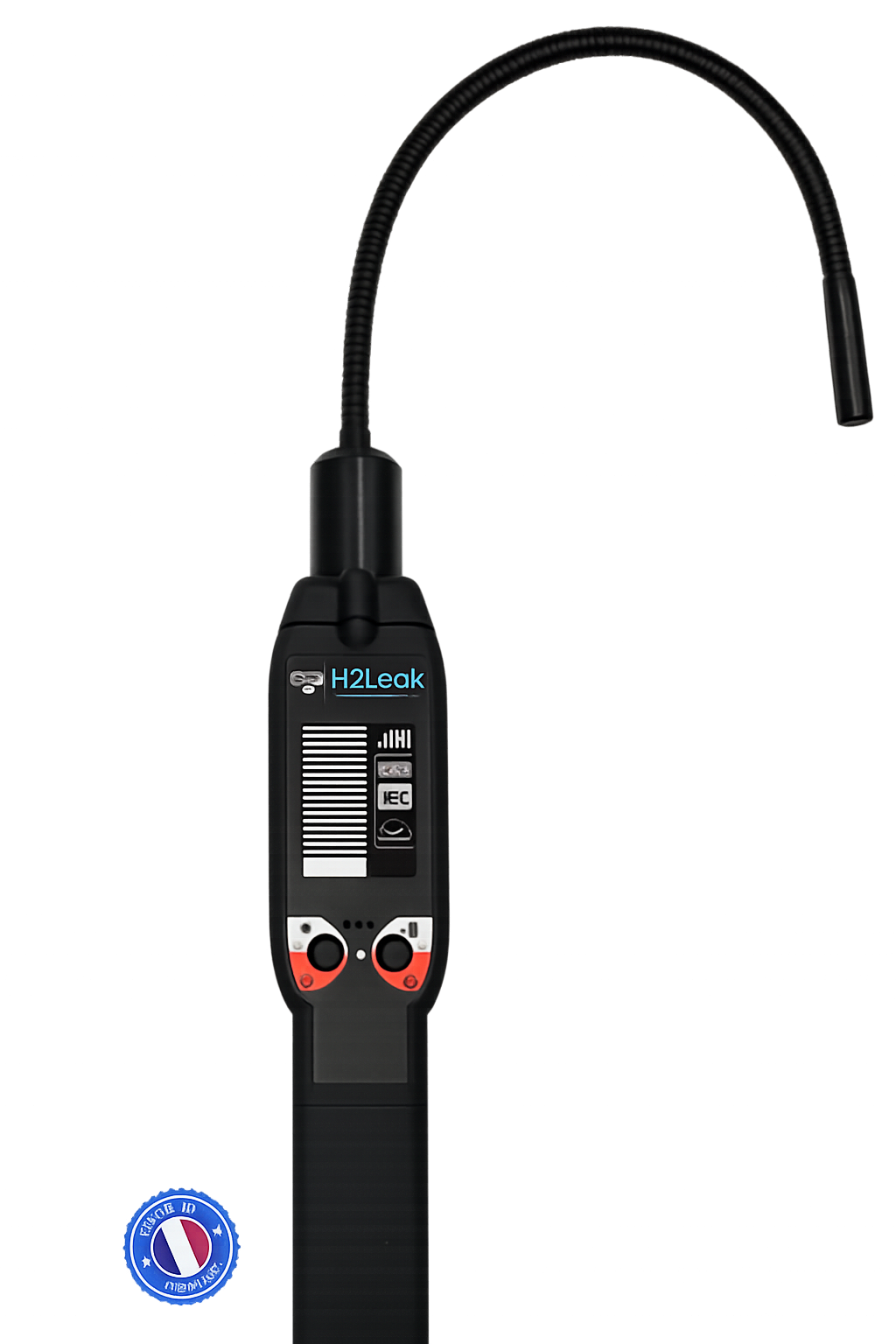
DXR-240 hydrogen + refrigerant detector · $1,190
A Tight Gauge Doesn't Mean a Tight System
Most store installs and repairs are signed off after a nitrogen hold. That test is good at one thing: proving there's no large hole. The leaks that drain a rack over twelve months are usually far too small to register.
Why a hold test struggles in a supermarket
A store rack can have thousands of brazed joints spread over hundreds of feet of piping. Over a 24-hour hold, ordinary temperature changes move the gauge more than a pinhole does. The test is static, so it never sees the vibration and thermal cycling that open small leaks once compressors start. And when it does show a drop, it gives no clue which of those thousands of joints is responsible. Many small leaks only reveal themselves after the system is full of refrigerant.
Common Leak Points from the Machine Room to the Roof
EPA has estimated a typical supermarket system loses around a quarter of its charge each year. That loss is spread across the whole store, which is why a technician needs a detector that can follow a trace through every zone.
The same approach carries over to distribution centers and cold storage feeding the stores, where very large charges make every lost pound costly.
Tracer Gas for Open Circuits, Refrigerant Sniffing for Live Ones
Store work splits into two situations. The DXR-240 handles both by switching detection cells and gas family.
Tracer gas mode
For new store builds, remodels, case resets and any circuit that's been recovered for repair.
- Pressurize with 5% H2 / 95% N2 forming gas.
- Finds leaks down to 1×10⁻⁵ cc/s, roughly 1 g/yr of refrigerant.
- The H2-selective cell ignores the refrigerant background that fills rack rooms and case aisles.
- Hydrogen, the smallest molecule, moves quickly through insulation and long runs to reach the probe.
Refrigerant mode
For scheduled leak inspections and service calls on charged, operating equipment.
- Detects HFCs, HFOs and hydrocarbons at 1 g/yr.
- Covers R-404A, R-407A, R-448A, R-449A, R-134a, R-410A and more.
- Reads R-290 and R-600a in self-contained cases as stores move to low-GWP equipment.
- No need to shut down cases or move product.
EPA Leak Repair at a Glance
The Emissions Reduction and Reclamation (ER&R) rule under the AIM Act took effect for leak repair on January 1, 2026. It applies to equipment holding 15 lb or more of an HFC or substitute refrigerant with a GWP above 53. The old cutoff was 50 lb, so walk-ins, remote case circuits and bigger rooftop units are now in scope alongside the racks.
Refrigeration trigger
Racks, cases and walk-ins must be repaired once the annual leak rate passes 20%. Catching small leaks early keeps systems under the line.
Comfort cooling trigger
Rooftop units and store HVAC face a stricter 10% limit, which leaves very little room for slow leaks.
days
Repair deadline
Leaks over the limit have to be found and fixed on a clock. Pinpoint location shortens the search, even on a recovered system.
tests
Verification & records
An initial and a follow-up verification test are required, along with records of charge, leak rate and repairs for each unit. A tracer gas re-test before recharging gives a clear, repeatable record.
General overview only. See 40 CFR Part 84 and current EPA guidance for the full rule and exemptions.
GreenChill
EPA's GreenChill partnership recognizes grocers that go beyond the federal minimum on refrigerant emissions, and its partners average much lower leak rates than the industry. Store certification levels, up to Platinum, are based on charge size and annual leak rate. Newly built stores must show documented leak tightness testing at installation, a natural fit for tracer gas before the first charge. Existing stores improve their standing by bringing the leak rate down year after year.
What a Lower Leak Rate Is Worth
Enter your own figures. Every pound that stays in the system is a pound you don't buy again, and with high-GWP refrigerants, a large cut in emissions.
Estimate only. Results depend on system design, refrigerant type and pricing. GWP values are AR4 100-year figures.
A Tracer Gas Leak Test, Start to Finish
- Isolate the workNew piping and case line-ups are ready as-is. On an existing circuit, isolate it and recover the refrigerant following EPA Section 608 practices.
- Prove strength with nitrogenUse a standard nitrogen pressure test to confirm the piping holds and rule out gross leaks.
- Charge with forming gasFill the circuit with 5% H2 / 95% N2, which costs about the same as nitrogen and is non-flammable.
- Sweep every jointRun the probe along brazes, case connections, valves and coils. The OLED ramp climbs and the tone rises as you close in.
- Fix, then prove itRepair what you find and re-sweep with tracer gas to confirm it's tight.
- Charge once and log itEvacuate, charge with refrigerant a single time and record the test. Afterward, switch to refrigerant mode for routine inspections.
Because no refrigerant is used as a test charge, nothing is vented while troubleshooting, and the system only gets charged after it's verified tight. That means fewer callbacks to the same rack, fewer warm cases and less risk of lost product.
DXR-240 at a Glance · $1,190
- Gases
- HFC, HFO, HC (R-290, R-600a) and H2/N2 tracer gas
- Sensitivity
- 1 g/yr refrigerant · 1×10⁻⁵ cc/s hydrogen
- Sensor cells
- Two interchangeable electrochemical cells: universal + H2, or H2-selective
- Cell replacement
- $190, about 2-year life, swapped in the field
- Settings
- HI / MED / LOW plus gas family selector
- Response
- ~1 s response, ~60 s warm-up
- Indicators
- OLED ramp, rising audible tone, contamination and battery alerts, work light
- Probe
- 30 cm flexible probe that holds its shape, with active suction
- Power & weight
- ~8 hr, USB-C charging · 12 oz (0.35 kg)
Ships with a carrying case, wall charger and manual. Not rated explosion-proof; keep out of hazardous locations.
Answers for Store Owners and Contractors
Why does a store system that passed a nitrogen hold still lose refrigerant?
A pressure hold only shows that a large leak exists. Pinholes in brazes, weeping Schrader cores and valve stems are too small to move the gauge, especially on a big rack where temperature swings hide small drops. Once the system runs, those leaks bleed refrigerant all year. Hydrogen tracer gas locates them individually before charging.
What store equipment is now covered by EPA leak repair rules?
Starting January 1, 2026, the EPA leak repair requirements under the AIM Act cover equipment holding 15 lb or more of an HFC or substitute with a GWP over 53, down from 50 lb. That brings in walk-ins, remote case circuits and larger rooftop units, not only the main racks. Refrigeration triggers repair at a 20% annual leak rate; comfort cooling at 10%.
Do cases have to be shut down to look for leaks?
No. On running equipment the DXR-240 is used in refrigerant mode and picks up HFC, HFO and HC refrigerants down to 1 g/yr while the store stays open. Tracer gas is reserved for new piping, remodels and circuits already recovered for repair.
What tracer gas is used and where can we get it?
The standard mix is 5% hydrogen in 95% nitrogen, often sold as forming gas. It is non-flammable and non-toxic, is stocked by welding and industrial gas suppliers, and costs roughly the same as dry nitrogen.
Can tracer gas testing help with GreenChill certification?
Yes. GreenChill requires documented leak tightness testing when a new store is installed, and existing stores are judged on annual leak rate. Tracer gas testing satisfies the first and helps drive down the second.
What does it cost to keep the detector running?
The main upkeep is the sensor cell, which runs $190 and typically lasts around two years. Technicians replace it in the field, so the detector never has to go back to the factory.
Bring Leak Rates Down Store by Store
Whether you run the stores, service them as a contractor or manage an in-house refrigeration team, we can help set up tracer gas testing that fits your work.
Talk to H2LeakH2Leak · 233 Arnold Mill Road, Suite 300, Woodstock, GA 30188 · (770) 479-7138